
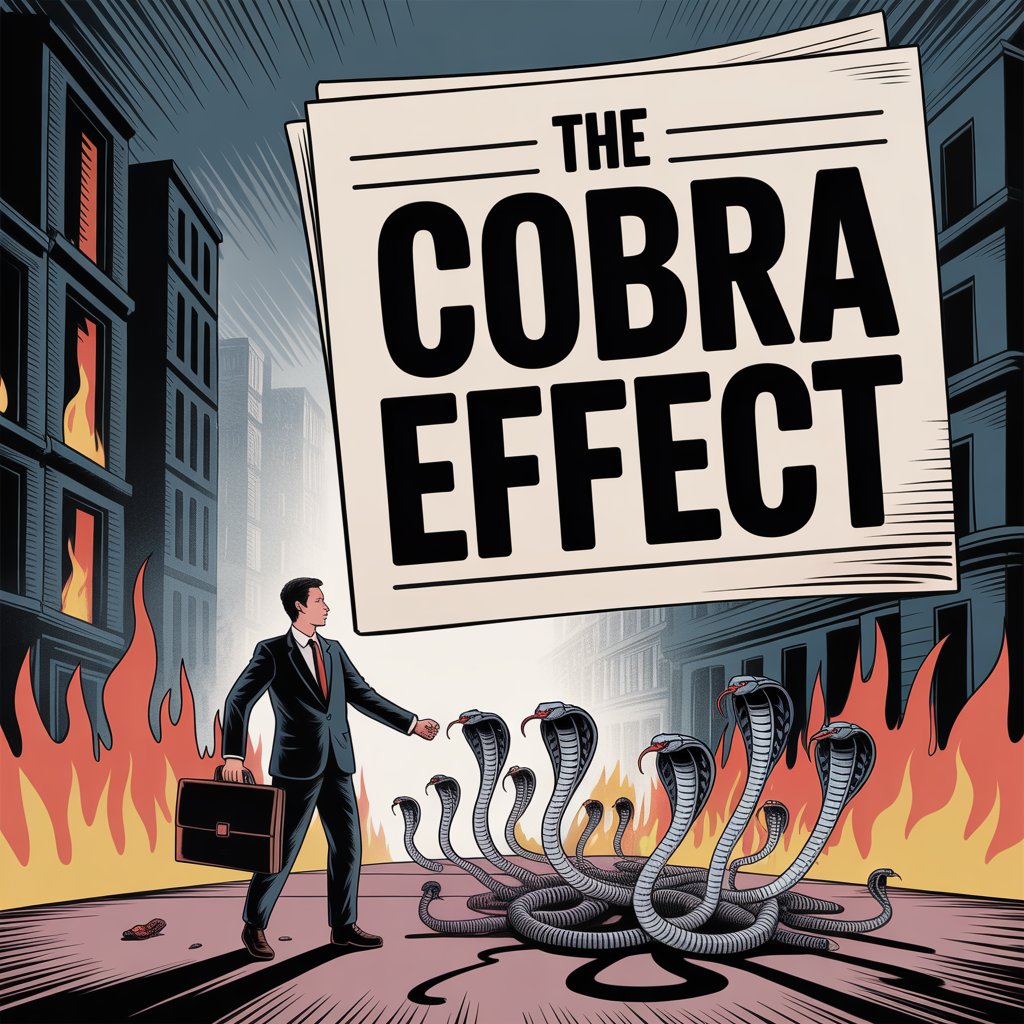
The Cobra Effect: When Incentives Backfire (and What It Teaches Businesses Today)
Most businesses believe incentives are the answer.
Want higher performance? Add a bonus.
Want faster results? Offer a reward.
Want a problem solved? Put a bounty on it.
Sounds logical… until it isn’t.
There’s a famous concept in economics and organizational behavior called the Cobra Effect—and it perfectly explains how well-intentioned incentives can quietly make problems worse.
The Origin of the Cobra Effect
The story dates back to colonial India.
The British government in Delhi was worried about the rising number of venomous cobras. To solve the problem, they offered a bounty for every dead cobra brought to the authorities.
At first, it worked. People started bringing in cobras. Payments were made. The numbers looked good.
But then something unexpected happened.
Some clever residents realized it was more profitable to breed cobras than to hunt them. When the government eventually discovered this and canceled the program, the breeders released their now-worthless snakes into the wild.
The result?
More cobras than before the policy existed.
That’s the Cobra Effect:
When an incentive designed to solve a problem ends up reinforcing or worsening it.
Why the Cobra Effect Happens
The mistake isn’t offering incentives—it’s assuming people will behave exactly as intended.
In reality:
- People respond to rewards, not intentions
- They optimize for what is measured, not what is meant
- They adapt faster than systems anticipate
When incentives are poorly designed, rational behavior at the individual level can produce irrational outcomes at the system level.
Modern-Day Examples of Incentives Gone Wrong
The Cobra Effect didn’t stay in colonial India—it shows up everywhere today.
1. Sales Targets That Kill Long-Term Growth
Aggressive sales commissions can push teams to:
- Overpromise to customers
- Push unsuitable products
- Ignore long-term relationships
Revenue spikes briefly, then churn, reputational damage, and refunds follow.
2. Paying for Speed, Not Quality
Organizations that reward “fast completion” often end up with:
- Poor-quality work
- Repeated revisions
- Hidden technical debt
Speed looks good on dashboards—until the cleanup costs more than doing it right the first time.
3. Education Systems Focused Only on Test Scores
When schools or teachers are rewarded purely on exam performance, outcomes may include:
- Teaching to the test
- Neglect of creativity and critical thinking
- Inflated scores without real learning
The metric improves. The mission suffers.
4. Aid and Humanitarian Incentives
In some aid programs, incentives tied to crisis metrics can unintentionally encourage:
- Overreporting problems
- Dependency rather than sustainability
- Short-term visibility over long-term impact
Again, rational responses—misaligned results.
The Real Lesson for Businesses and Organizations
The Cobra Effect isn’t about bad intentions. It’s about simplistic thinking in complex systems.
Before introducing any incentive, leaders should ask:
- What behaviors could this reward unintentionally encourage?
- What happens if people try to game this system?
- Are we measuring outcomes—or just activity?
- What second- and third-order effects might emerge?
Good incentives align individual success with organizational success. Bad ones create shortcuts, distort behavior, and quietly undermine strategy.