
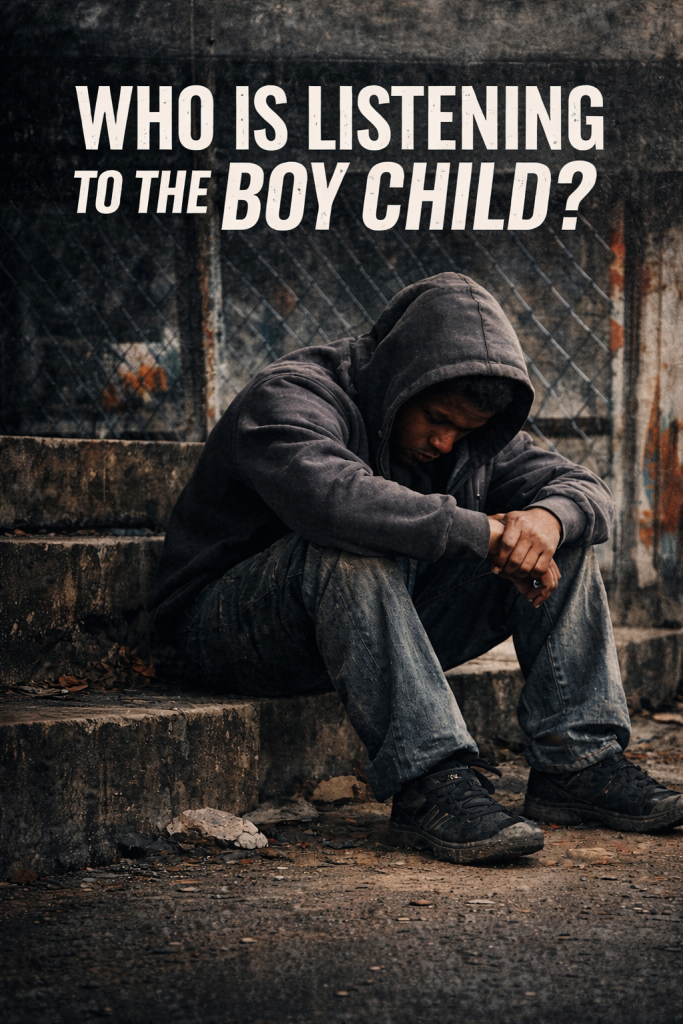
The Silent Crisis: Who Is Listening to the Boy Child?
According to the National Crime Research Centre, over 300 active criminal gangs are operating across 11 key counties in Kenya. Mombasa leads with 73 gangs, followed by Nairobi with 56 and Kilifi with 47. These groups, often made up of young people in urban and coastal areas, are involved in armed robbery, extortion, and drug trafficking. Many of them have even been banned, only to resurface under new identities.
But these are not strangers.
They are not distant statistics.
They are people we see every day.
They are our brothers.
There is a growing conversation about inequality and empowerment in our society, and rightly so. But somewhere along the way, the boy child has quietly slipped through the cracks. Not in dramatic fashion, but slowly, almost invisibly, like a roof leaking one drop at a time until the whole house feels it.
Today, men make up the overwhelming majority of those in prison, in gangs, and tragically, those dying by suicide.
In Kenya, men are between three to five times more likely to die by suicide than women. While women may attempt suicide more often, men tend to use more lethal methods. The numbers tell a sobering story:
- Men are four times more likely to die by suicide than women
- In 2020, there were 138 reported male suicide deaths compared to 36 among women
- In some regions like Kilifi, men account for over 80% of suicide cases
- Studies show significantly higher suicide rates among men, especially in rural areas
Behind these numbers are deeper issues. Cultural expectations teach men to suppress emotion. A man is expected to endure, to provide, to “figure it out.” But no one teaches him how.
Silence becomes his language.
Pressure becomes his shadow.
The same pattern reflects in the prison system. Kenya has approximately 55,000 to 60,000 inmates, and nearly 90% of them are men. That is tens of thousands of men—many of them young—caught in cycles of crime, punishment, and lost potential.
And the story doesn’t stop there. Around 90% of gang members are also male.
This is not just data. It is something unfolding in real time.
Just days ago, I witnessed young men between the ages of 14 and 20 fighting on the streets. In one instance, they had stolen a phone, and when the money from its sale was not shared “fairly,” they turned on one of their own, beating him as a form of justice. A few days later, around April 1st, a 17-year-old boy was stabbed in Eastleigh by fellow youths.
These are not isolated incidents. They are symptoms.
Symptoms of a deeper neglect.
The question then becomes: where did we lose them?
Many young men today grow up carrying invisible weight. They feel pressure to succeed but are rarely shown how. They experience emotional pain but lack the language to express it. They are expected to lead, yet often walk alone.
And when guidance is missing, something else steps in to fill the gap—gangs, crime, substance abuse, or silence.
This is not about dismissing the importance of women’s empowerment. Women have faced systemic marginalization for generations, and supporting their progress remains essential.
But addressing one side of society while neglecting the other creates imbalance.
Because the truth is simple:
A broken man does not exist in isolation.
When a man joins a gang, communities suffer.
When a man is imprisoned, families are affected.
When a man dies by suicide, entire households grieve.
The impact ripples outward.
If we want a peaceful society, we must raise balanced individuals.
The government, communities, and organizations all have a role to play. We need to invest in mentorship programs for boys, create safe spaces for emotional expression, and provide real opportunities for growth and purpose.
Young men do not just need discipline.
They need direction.
They need support.
They need to be seen.
Because in the end, a society cannot truly thrive when half of it is silently struggling. And no matter how far we push forward, peace will always remain out of reach if we do not bring the boy child along with us.